Short answer
In Washington, workers in a trench 4 feet deep or more must be protected from cave-ins by sloping, shoring or a trench box. A shallower trench needs protection too if a trained person sees any sign the soil could cave. The federal cutoff is 5 feet. This applies to construction crews in Clark County.
What is the depth where protection is required?
Four feet. As of November 2026, WAC 296-155-657 says each worker in an excavation must be protected from cave-ins by a protective system. There are only two exceptions:
- The dig is made entirely in stable rock.
- The dig is less than 4 feet deep, and a competent person has checked the ground and found no sign of a possible cave-in.
So 4 feet is not a free pass for shallow trenches. A 3-foot trench in loose, wet soil can still need protection.
Washington is stricter than the federal rule here. Federal OSHA sets the same exception at less than 5 feet, in 29 CFR 1926.652. Jobs in Vancouver and Clark County follow the Washington number.
Rules change. Confirm the current rule with the Washington Department of Labor and Industries, called L&I.
What counts as a protective system?
There are three common kinds. The contractor picks one that fits the soil and the depth.
- Sloping. The trench walls are cut back at an angle so they cannot fall in. The rule’s basic option is a slope no steeper than 1.5 feet back for every 1 foot down.
- Shoring. Braces and panels press against the walls and hold them up.
- A shield, often called a trench box. This is a steel or aluminum box that sits in the trench. Workers stay inside it.
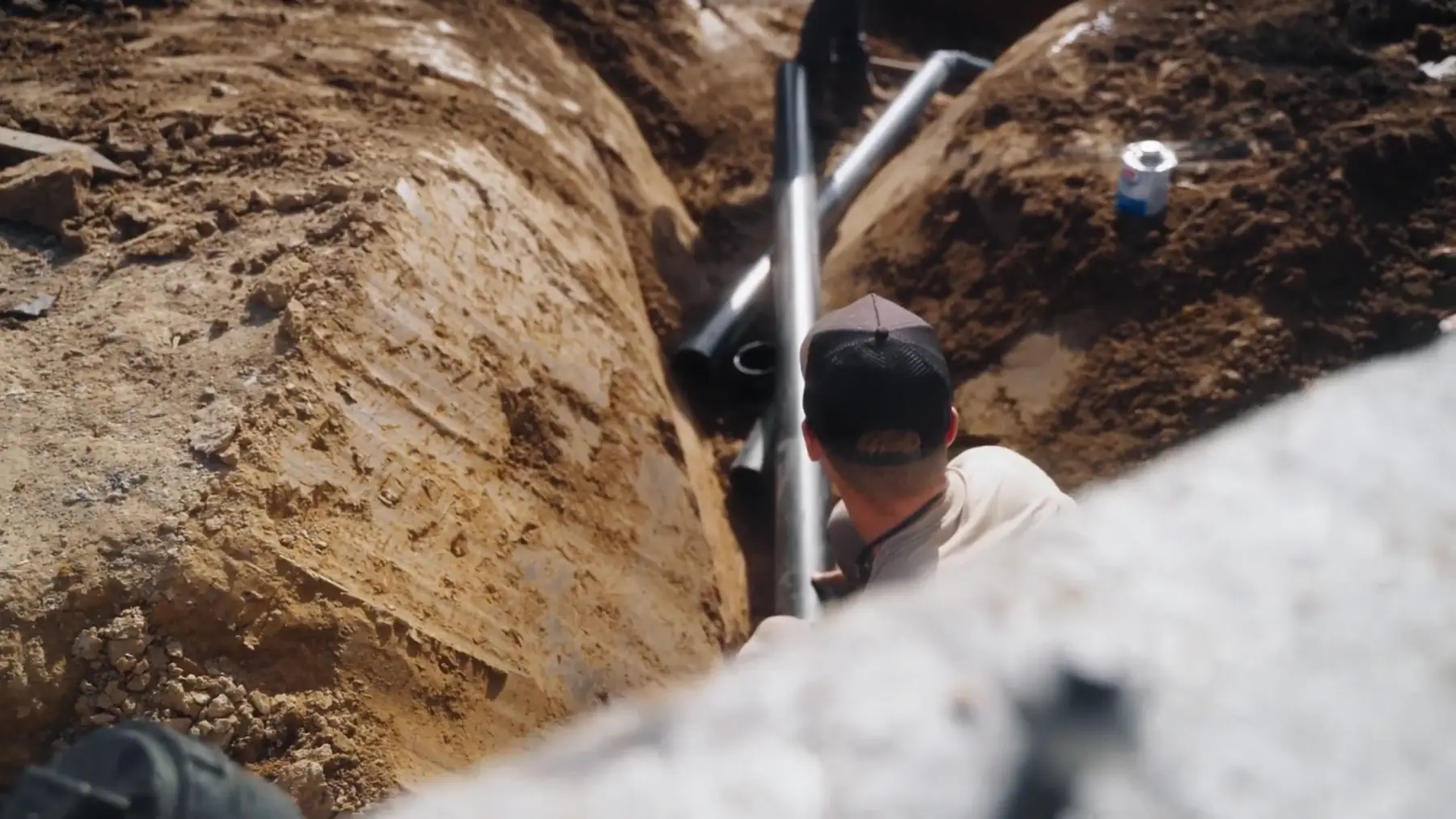
Why so much care for a 4-foot hole? L&I says one cubic yard of soil can weigh as much as a car. A wall of dirt does not need to be tall to trap a person.
Who is the competent person?
It is the person on the crew who can spot trench hazards and has the power to fix them. Washington’s rule defines a competent person as one who can identify existing and predictable hazards. That person must also be authorized to take prompt action to remove them.
Two parts of WAC 296-155-655 matter for your job:
- A competent person must stay on the job site any time trench work is being done.
- A competent person must inspect the trench, the area around it and the protective system every day.
The daily inspection happens before work starts and as needed through the shift. Another inspection is required after every rainstorm. In Clark County’s wet season, that can mean many inspections in a week. See excavation in the rainy season for more on wet ground.
If the inspection finds a hazard, workers must leave the area until it is fixed.
What should I see when I look at a trench on my job?
You should see a way out, a clear edge, and protection that matches the depth. Here is a short list drawn from WAC 296-155-655.
- A ladder or ramp. A trench 4 feet deep or more needs a ladder, stairway or ramp. No worker should have to travel more than 25 feet along the trench to reach it.
- Dirt piles set back. Dug soil, called spoil, must be kept at least 2 feet from the edge. Tools and equipment follow the same rule.
- No one under a load. Workers may not stand under a bucket or any lifted load.
- Water under control. Workers may not work in a trench where water is building up unless steps are taken to protect them.
- Bright vests near traffic. Workers exposed to traffic must wear high-visibility garments.
- Marked utilities. Buried lines must be located before the dig opens. See what 811 marks and what it skips.
If you see a worker chest-deep in a straight-walled trench with no box and no ladder, something is wrong.
Is there paperwork for a trench now?
Yes. Since June 1, 2026, Washington requires a written trench excavation work plan. It applies to any trench a worker may enter where a protective system is required.
The competent person fills it out. It covers the soil type, the buried utilities, the protective system, the way out, and how often the trench gets inspected. Workers must be trained on the plan before they go in. The plan must be on site for L&I to inspect.
A written plan is not required when the trench is sloped back at 1.5 to 1 or flatter. L&I posts a plan form on its trenching page.
If you are a general contractor, ask your excavation sub for the plan before trench work starts.
Do these rules apply to a homeowner digging alone?
The rule is written for employers and their workers. It tells employers what they must do to protect employees. If you hire a contractor with a crew, the rule applies to that crew on your lot.
The soil does not know who is in the trench, though. If you dig your own trench, the same numbers are a good guide. Past 4 feet, slope it or stay out.
Utility trenching is part of our underground utility work. Whoever you hire, ask how the crew will protect the trench before the first bucket comes out.
Do this now
- Ask your contractor how deep the trench will be at its deepest point.
- Ask which protective system the crew will use: sloping, shoring or a trench box.
- Ask who the competent person is, and confirm that person will be on site during trench work.
- For a trench that needs protection, ask to see the written trench excavation work plan.
- Keep kids, pets and visitors well back from any open trench on your lot.
More questions
Is the 4-foot rule the same in Oregon?
Oregon and Portland have their own rules. This page covers Washington only.
Can a trench under 4 feet cave in?
Yes. That is why the rule still requires a competent person to check the ground before workers go in an unprotected shallow trench.
How far apart can ladders be?
A worker in a trench 4 feet deep or more must never be more than 25 feet of travel from a ladder, stairway or ramp.
Sources
- Washington Legislature: WAC 296-155-657, Requirements for protective systems (read November 23, 2026)
- Washington Legislature: WAC 296-155-655, General protection requirements (read November 23, 2026)
- Washington State Department of Labor and Industries: Trenching Excavation (read November 23, 2026)
- OSHA: 29 CFR 1926.652, Requirements for protective systems (read November 23, 2026)
Written by Lindberg Pipe & Grade, an excavation contractor in Vancouver, WA since 2008, from the agency pages and codes listed above. Rules and fees change. This is general information, not legal or engineering advice, so check with the permit office for your address before work starts.